
|
Key Takeaways: In this article homeowners will learn more about investing in a new patio installation for their outdoor space. Learn about the materials available to use for your new patio and how to decide what size is right for your outdoor space. |
What Do I Need to Know About Investing in a New Patio?
Investing in a patio is one of the most practical and lifestyle-enhancing upgrades you can make as a new or seasoned homeowner. A patio sits at the intersection of usable square footage, curb appeal, and resale value, which is why both contractors and real estate professionals consistently recommend it. Below is a structured breakdown to help homeowners evaluate this investment like a professional would.
What are the Benefits of a New Patio?
A patio is one of the rare home upgrades that delivers: immediate lifestyle improvement, strong resale value and flexible scalability over time. When done correctly, it becomes an extension of your home that provides both financial and lifestyle benefits.
Financial Benefits
- Strong return on investment: Many patio projects recover 60%–95% of their cost at resale depending on quality and design.
- Increased buyer appeal: Outdoor living spaces are a major selling point and can improve “livability scores” significantly.
- Low maintenance vs decks: Patios generally require less upkeep than wood decks, improving long-term cost efficiency.
- Scalable investment: You can start with a basic patio and add features like; a fire pit, seating walls, and lighting later on.
Physical / Lifestyle Benefits
- Expands your functional living space outdoors
- Creates a designated area for entertaining, dining, or relaxing
- Improves flow between indoor and outdoor areas
- Enhances landscape structure and drainage control
- In coastal climates (like Virginia), patios handle humidity and salt air better than wood structures
What are the Best Materials for a New Patio?
Choosing the best patio material comes down to balancing five important factors; durability, maintenance, climate performance, aesthetics, and cost. Below is a clear breakdown of the top materials professionals consistently recommend, along with real product examples so you can visualize what each looks like in practice. In coastal Virginia materials that handle moisture, salt air, and ground movement (like pavers or stone) outperform poured concrete in the long-term.
Stamped Concrete
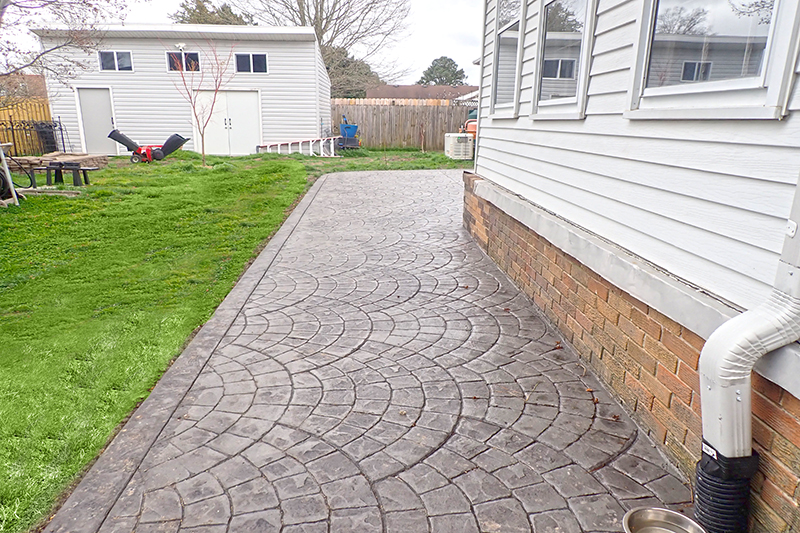
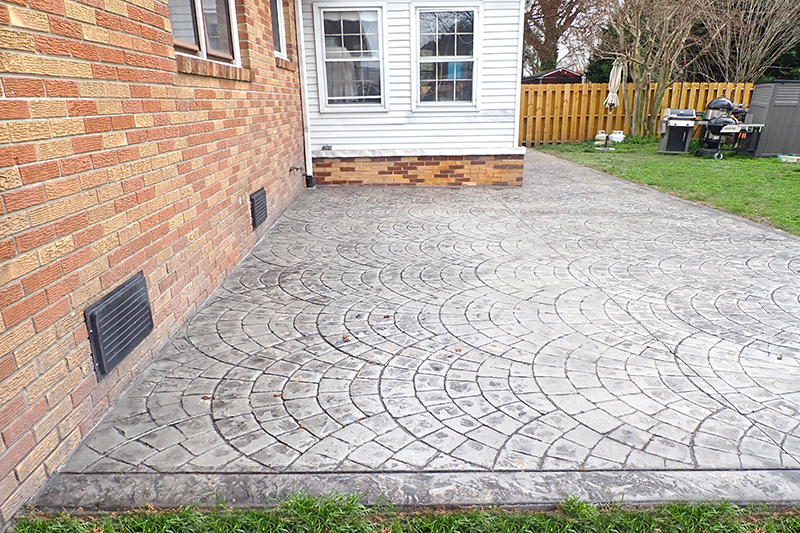
Best for: Entry-level patios or large areas on a budget. Stamped concrete is concrete that has been colored and imprinted to replicate slate, flagstone, tile and brick. It is a beautiful option for patios, driveways, walkways, entries, courtyards and pool areas. Stamped concrete is popular for the color and pattern options it offers at a very affordable price. It is considerably lower than the materials whose patterns it replicates. It’s more than just concrete, it’s your outdoor flooring.
Cost: ~$10–$18/sq ft *best budget option
Pros: Affordable, Customizable colors including; Ashlar Slate, Random Stone, London Cobblestone, European Fan, Quick installation
Cons: Can crack over time
Pavers
Best Overall Choice for: Long-term investment + aesthetics.
- Cost: ~$15–$25/sq ft
- Pros: Highly durable, Easy to repair (replace individual pavers), Strong resale value
- Cons: Higher upfront cost than concrete

Natural Stone (Premium Option)
Best for: Luxury outdoor spaces
- Cost: ~$20–$30+ per sq ft
- Pros: High-end look, Excellent durability, Strong ROI (20–30%+ baseline)
- Cons: Expensive, More labor-intensive

Brick (Classic Look)
Best for: Traditional-style homes
- Cost: ~$10–$20/sq ft
- Pros: Timeless aesthetic, Eco-friendly
- Cons: Can chip/crack

| Patio Size | Square Footage | Typical Use | Estimated Cost Range |
|---|---|---|---|
| Small (10x10) | 100 sq. ft | Seating area | $1,000 – $5,000 |
| Medium (12x20) | 240 sq. ft | Dining + seating | $3,500 – $9,000 |
| Large (20x20) | 400 sq. ft | Full outdoor living | $8,000 – $20,000 |
| Extra Large (20x30+) | 600+ sq ft | Entertaining space | $12,000 – $30,000+ |
Strategic Recommendations to Receive the “Best Value”
If you’re approaching this like a smart investment follow these recommendations to experience the best ROI:
- Choose pavers → best balance of durability, aesthetics, and ROI
- Build ~300–400 sq ft → optimal size for usability and cost efficiency
- Keep design simple initially → add features later
- Invest in base prep + drainage → prevents expensive repairs
Some More Important Things to Consider
Here are some other important things to consider when you are planning your new patio installation.
- Base Preparation is Everything
From both contractors and real-world experience:
- Poor base prep leads to shifting, sinking, and costly repairs later
- Proper excavation, gravel base, and compaction are non-negotiable
- Ask your contractor specifically about drainage and base depth
- Design for Function First
- Think zones: dining, lounging, grilling
- Plan for traffic flow and furniture spacing
- Consider future upgrades (pergola, outdoor kitchen)
- Keep It Simple (Initially)
- Rectangular layouts are cheaper than curves or multi-level builds
- Complex designs increase labor significantly
- Plan for Drainage (Critical in Coastal VA)
- Slight slope away from the home
- Avoid water pooling (major long-term issue)
- Hire a Professional Installer
- Labor typically adds $4–$11 per sq ft
- Ensures compliance with codes and longevity
Hear it from the Professionals, What Contractors Emphasize
A patio from Dr. Dan’s Landscaping & Architectural Design can bring a welcoming and relaxing vibe to any backyard. Our patio designers in Virginia Beach and Chesapeake will help you determine the best materials for your patio based on your overall budget, the topography of your yard and the condition of your yard. We take into consideration the grading and slope, trees and roots, drainage and erosion. We customize every new patio installation for shape, style and function.
Patio designs are only limited by your imagination! We offer a variety of elements to create a patio that is truly unique to your vision by using;
- Concrete
- Stamped Concrete
- Pavers
- Concrete with paver trim
- Gravel
- Gravel with slate accents
- Flagstone
- Wood decking
Call (757) 496-8100 Today or Request a Consultation Now.
Hear it From Our Customers
“We reached out to Dr. Dan’s to get an estimate on our backyard patio project. Throughout the whole project, Lorraine, Dr. Dan, and their team helped adjust our ideas with budget in mind. They gave great suggestions for improvement, and were timely in all communication. They also completed the project quickly and just in time for summer! We could not be happier with the results of our stamped concrete patio, as well as the drainage systems and utility areas that were created, and we are incredibly happy to have worked with such a professional team! Our once empty backyard is now coming to life!”
– Victoria LaVeck
“Here’s my story- requested a quote online, I was contacted the next day, quoted on the spot when they arrived and the work was completed two days later.It literally took 3 days only for the entire process. Unreal! It was that easy. We had an old slab from when the house was built removed and they doubled the size of the new one with brush finish and dividing lines to help from cracking. It was a five man crew that just delivered- worked fast, clean, they washed the house around the work, they didn’t destroy my yard with equipment, poured from the mixing truck and stayed to make sure it was setting and to finish. Their crew even came back to make a spot for our families hand prints and had to do it twice even because my son moved too much lol.Dr Dan came to my house and walked me through every step from confirming what we wanted to making sure it set. We also had several text conversations and didn’t even hesitate, responded and made sure I was ok. He came by a few days after to check out the work of his crew and I told him I owed him the remaining balance, “don’t even stress over it, just stop by or mail it in- I know your good for it.” He was like working with a friend and he was more concerned with the work and our approval than the money. Again, you’re going to find that anywhere else. Bottom line: extremely professional, extremely easy to communicate with from calls to texting, clean and beautiful work- craftsmen not just a quick poor. Pricing was exactly what I wanted. It was cheaper than putting down a composite deck. Thank you very much for you’re services and I hope my friends will use you too.”
– Nicholas Meroni
I had a patio placed in my back yard and it is absolutely stunning! The finish is shiny and smooth and they even put in a drain in the middle so that my fire pit does not fill with water when it rains. I also had dry wells put in the back and front yard. The employees went above and beyond, clearing yard debris and raking leaves that had fallen under my child’s play set. The work is phenomenal as is the customer service. Danny and Lorraine are great to work with, they kept me updated on the progress of the projects, and Danny came by frequently to monitor how things were going. I will definitely be using them again for future projects.
-Rebecca Wolfe
Frequently Asked Questions: New Patio Installation
What is the average cost to install a patio?
The average cost to install a patio typically ranges from $10 to $30 per square foot, depending on materials, labor, and site conditions. For a standard 300 sq ft patio, most homeowners spend between $3,500 and $9,000.
- Basic concrete patios: $8–$15/sq ft
- Concrete pavers: $12–$25/sq ft
Natural stone: $20–$40+/sq ft
How much does it cost for someone to install a patio?
Labor usually accounts for 40%–60% of the total project cost. Professional installation can range from; $5 to $15 per square foot for labor alone, depending on complexity, grading, and prep work. Factors that increase labor cost:
- Sloped yards
- Drainage requirements
- Custom patterns or layouts
- Demolition of existing structures
How long before I can walk on a newly laid patio?
- Concrete: Wait at least 24–48 hours before light foot traffic; full curing takes about 28 days
- Pavers: You can typically walk on them within 24 hours after installation
Is it cheaper to lay pavers or concrete?
Concrete is usually cheaper upfront, especially poured or stamped concrete. However, pavers may be more cost-effective long-term due to easier repairs and longer lifespan.
What is the best time of year to lay a patio?
The best time is typically spring through early fall. Especially in coastal areas like Virginia, spring and fall are ideal due to milder weather and stable soil conditions.
- Moderate temperatures (50°F–80°F)
- Low moisture levels
- Minimal freeze/thaw cycles
What lasts longer, concrete patio or paver patio?
Paver patios generally last longer than poured concrete. Pavers are more flexible and better handle ground movement.
- Pavers: 30–50+ years (with maintenance)
- Concrete: 20–30 years (prone to cracking over time)
Is it cheaper to pour concrete or pavers?
This overlaps with earlier cost questions, but in short:
- Poured concrete: Lower upfront cost
- Pavers: Higher upfront cost, but better long-term value due to repairability
What do you put under concrete pavers?
A proper base is critical for longevity. Standard layers include:
- Compacted subgrade (soil)
- Gravel base (4–8 inches) for drainage and stability
- Bedding sand (1 inch) for leveling
- Pavers + joint sand (often polymeric sand to lock them in place)
What is the best time of year to lay pavers?
Similar to general patio installation:
- Spring and fall are ideal
- Avoid:
- Freezing temperatures
- Extremely hot conditions (can affect sand and settling)
What are the disadvantages of concrete pavers?
While highly recommended, pavers do have some drawbacks:
- Higher upfront installation cost
- Can shift or settle if improperly installed
- Weed growth between joints (if not sealed)
- Require occasional maintenance (re-sanding, sealing)